
Gratiot County Arrest to Court Records
The local path from arrest to court record usually starts at the sheriff-operated Gratiot County Jail and then moves to 65B District Court. District Court handles arraignments, misdemeanor matters, probable-cause conferences, preliminary examinations, traffic and criminal proceedings, and bond-related hearings. Felony matters can move to the 29th Circuit Court after bindover, waiver, or another court action. That means a jail booking can exist before the court file is complete, and the court record may later show a different charge set than the first booking entry.
The Gratiot County Prosecuting Attorney is the office that bridges the police arrest request and the formal case. The official county page says Prosecuting Attorney Laura Bever reviews complaints from police and citizens, issues warrants, and represents the State in criminal and juvenile cases. For a reader trying to find court records after a jail arrest, that role matters. The prosecutor decides what complaint, warrant, or charging path to pursue, while the court records the filed case, hearings, bond, and disposition.
Booking details, custody status, and jail holds belong to Gratiot County jail inmate records. Booking photos and image-field issues belong to Gratiot County jail mugshots. The court record is different. It is the case file and docket trail that show what charges were filed, whether a count is pending, amended, reduced, dismissed, or resolved, and which court currently has the case.
Find Gratiot County Court Records
The main online lookup channel is MiCOURT Case Search, the statewide court case-search portal linked from Gratiot court pages. The 65B District Court also posts a live court docket that refreshes every 30 minutes and omits non-public cases. Those sources are useful at different points. MiCOURT is the case-search tool. The live docket is better for near-term hearings, names, times, case numbers, CTNs, and hearing information that is public that day.
The 65B District Court record-access page adds an important fallback. Court staff provide record checks by mail, phone, fax, or in person. The court computerized in 1996, so older records are available through manual index books at the counter by appointment or public review. Copy requests by mail, phone, or fax must be paid before copies are released, and screen prints are listed at one dollar per page.
| Search Field | Type | Required | Notes for Gratiot County |
|---|---|---|---|
| Court selection | Dropdown or filter | Likely required | Use the Gratiot court or case type when the portal asks for a court filter. |
| Party or defendant name | Text | Not specified | Search the person's legal name from the roster, ticket, complaint, or docket. |
| Case number | Text | No | Best when copied from JailTracker, a court notice, MiCOURT, or the live docket. |
| Case type | Filter | No | MiCOURT can include criminal, traffic, civil, domestic, and probate case types depending on court coverage. |
| Date or docket controls | Date or list | No | The 65B live docket lists public events by date and time and refreshes every 30 minutes. |
The official MiCOURT portal is the state search screen for public court cases after arrest. Its value is strongest when a name, case number, or court filter is known.
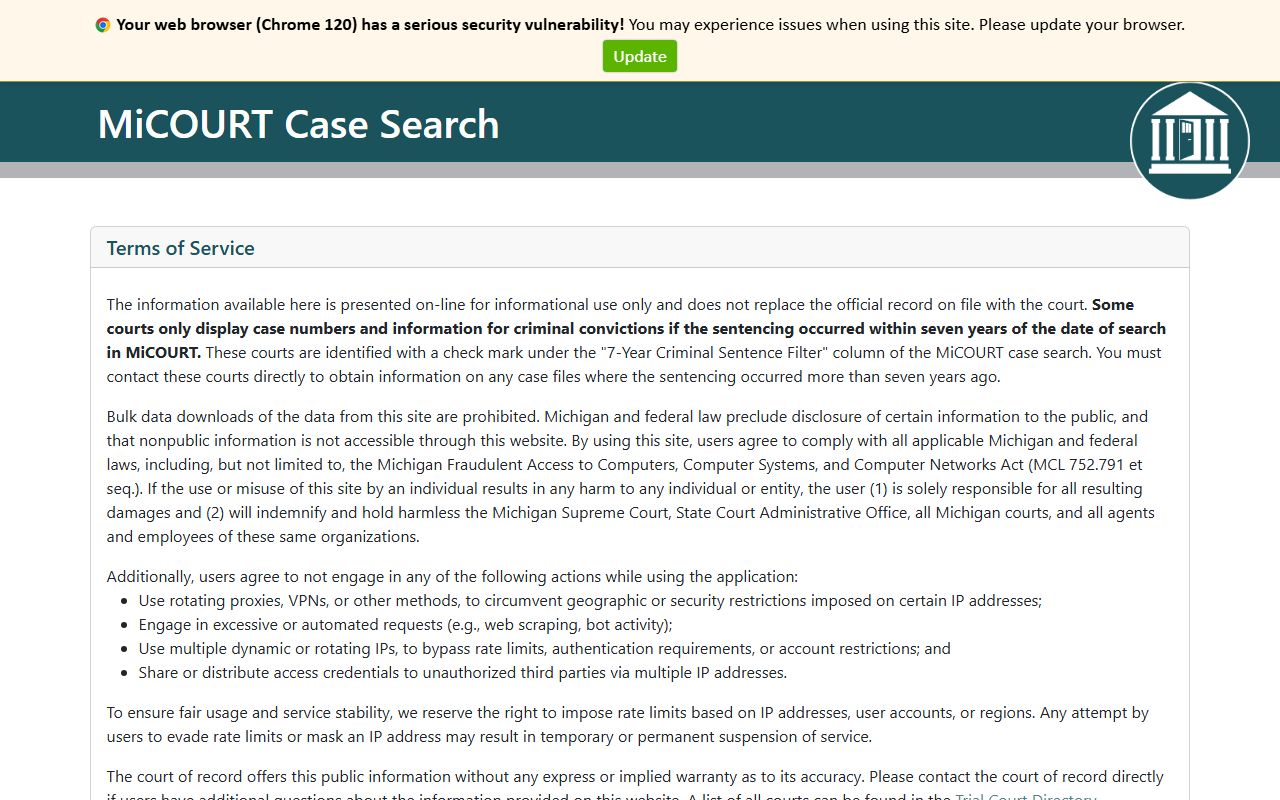
Use MiCOURT together with the local docket because an arrest may produce a booking record first, then a public court event once the case is opened or scheduled.
Gratiot County Court Record Workflow
A court records after arrest search works best as a sequence, not as one search box. JailTracker may show booking charges and bond fields. MiCOURT may show the filed case. The live docket may show the next hearing. Court staff can check public records when the electronic systems do not answer the question, and the Circuit Court Clerk becomes important when a felony leaves District Court after bindover.
- Search the Gratiot JailTracker roster for the person and note any case number, warrant number, charge text, bond type, or court date that appears.
- Search MiCOURT by defendant name and Gratiot court details when the case is public and electronically available.
- Check the 65B live docket for arraignment, probable-cause conference, preliminary examination, criminal-division, or bond hearings.
- Contact 65B District Court for record-check help at 989-875-5240 or 65bdistrictcourt@gratiotmi.com when the public portal is incomplete.
- For felony cases after bindover, use the Circuit Court Clerk route. Gratiot case scheduling uses 989-875-5224 according to the court research.
Older court records need special care because Gratiot's district court computerized in 1996. If a post-arrest court record is older than that, the manual index books may be the correct route. If a recent case is absent from the docket, it may be too new, sealed, non-public, in a different court, or listed under a different spelling.
Gratiot County Charging Records
Charges filed after an arrest may start as a complaint, proceed through an information in a felony case, or in rare matters appear through an indictment. Routine local cases in Michigan are most often discussed in terms of complaints, warrants, preliminary stages, bindover, and prosecutor-filed felony information. The research identifies the Gratiot prosecutor as the office that reviews complaints and issues warrants, while 65B District Court magistrates review and authorize criminal warrants.
| Document | Who Uses It | What It Means | How It Relates to Jail Booking |
|---|---|---|---|
| Complaint | Prosecutor or authorized charging process | Begins or states the criminal accusation in court. | May differ from the arresting-agency charge first shown on the jail roster. |
| Information | Prosecutor | Formal felony charging document after bindover, waiver, or related procedure. | Often appears after the case moves beyond early District Court stages. |
| Indictment | Grand jury process | Formal charge returned by a grand jury. | Less common in routine local Gratiot County arrest searches. |
The charging document should not be read as a conviction. It is an accusation or formal charge path. A court record may later show an amended complaint, reduced count, dismissal, plea, verdict, sentence, or transfer to another court. That is why court records after a jail arrest need both the first charge list and the case disposition.
Gratiot County Charge Status
Status terms explain where each count stands. A pending charge is not a conviction. An amended charge means the wording or count changed. A reduced charge usually means a lower severity or different offense replaced the earlier count. A dismissal ends that count without a conviction. These terms can sit next to bond, warrant, hold, or hearing information, so the same case can have more than one status at once.
| Status | Plain Meaning | Search Tip |
|---|---|---|
| Pending | The charge remains unresolved in court. | Check the next hearing on MiCOURT or the 65B docket. |
| Amended | The charge language, code, count, or filed document changed. | Compare the latest court record to the booking charge. |
| Reduced | A less severe or substitute charge replaced the earlier count. | Review the disposition line, not only the original roster text. |
| Dismissed | The count ended without conviction on that count. | Look for other counts that may still be active. |
| Convicted | A guilty plea, verdict, or adjudication resolved the charge. | Use the disposition and sentence fields when available. |
The 65B District Court docket helps identify public hearing activity after arrest. It is not a full case file, but its 30-minute refresh makes it useful when a person has a near-term court date.
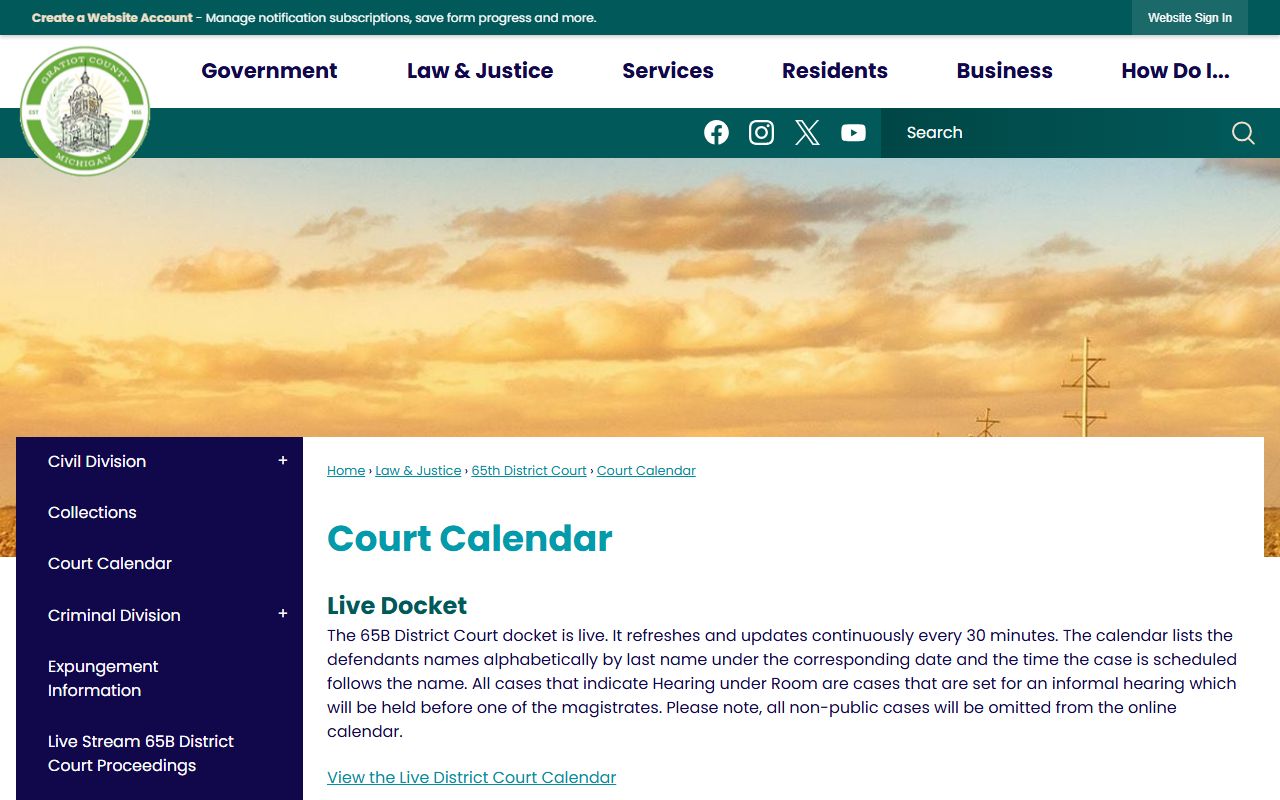
Because non-public cases are omitted, absence from the docket should not be treated as proof that no arrest, charge, or court event exists.
Bond and Warrants After Arrest
Bond links the court, the jail, and the payment channel. The Sheriff's Office links to Express Account for bond and inmate accounts. The District Court page links to online payment services for court amounts, but bond release should be verified with the jail or court before payment. The sheriff annual reports also separate bond money returned to District Court, Circuit Court, Friend of the Court, and out-of-county categories, which shows that the correct court or agency matters.
| Bond or Hold Type | How It Works | Release Issue |
|---|---|---|
| Cash bond | Money is deposited with the correct court, jail, or approved vendor. | Payment must match the correct case or agency. |
| Surety bond | A bail agent or surety may back the bond where allowed. | Confirm local acceptance before relying on it. |
| Personal recognizance | The court releases the person on a promise to appear. | No full cash payment is the key feature. |
| No-bond hold | A court or agency blocks release by bond. | Payment will not clear the hold by itself. |
| Detainer or warrant hold | Another court, MDOC, parole, probation, federal, or out-of-county agency may keep custody active. | Check the holding agency and the case source. |
Gratiot County research did not locate a standalone sheriff active-warrant search portal. Warrant checks therefore use the court, jail, MiCOURT, and records-request chain. The prosecutor reviews complaints and issues warrants, while court magistrates review and authorize criminal warrants. If someone is booked on a warrant, JailTracker fields may include warrant number, hold reason, court name, bond type, bond amount, charge status, and case or control number when those fields are configured for display.
Charges Versus Convictions
A Gratiot County arrest and charge record is not the same as a conviction record. A charge is an accusation filed or pursued through the criminal process. A conviction follows a guilty plea, verdict, or qualifying adjudication. This distinction is central when reading court records after a jail arrest because the booking charge may be amended, dismissed, reduced, or replaced before the final disposition appears.
| Issue | Charge | Conviction |
|---|---|---|
| Case stage | Accusation or filed count. | Final finding through plea, verdict, or adjudication. |
| Proof level | Based on arrest, complaint, warrant, or probable-cause process. | Requires proof beyond a reasonable doubt or a valid plea. |
| Record meaning | Shows what was alleged. | Shows what was legally resolved against the defendant. |
| Search risk | Can be misread if the disposition is ignored. | Must still be checked for set-aside, appeal, or later court action. |
Sealed and Expunged Court Records
Michigan public access is broad but not unlimited. The research points to Michigan FOIA, court access rules, juvenile limits, sealed charges, expunged or set-aside records, and statutory exclusions in systems such as OTIS. A public court records after arrest search may miss a case because it is non-public, sealed, too old for the electronic index, under a different court, or legally removed from public view.
| Issue | Sealed or Non-Public | Expunged or Set Aside |
|---|---|---|
| Public view | Hidden from general public access by law, court rule, or case status. | Removed from ordinary public record access after a court or statutory action. |
| Agency access | Some court or law-enforcement access may remain. | Limited access may remain for specific legal purposes. |
| Common reasons | Juvenile matter, sensitive record, non-public case, or sealed court order. | Eligible conviction or arrest information is set aside or expunged. |
| Search result | The public portal may omit the case or event. | OTIS and public court tools may remove or suppress eligible information. |
Michigan access law: Michigan FOIA, Act 442 of 1976, allows access to nonexempt public records of public bodies. It does not override sealed, juvenile, expunged, security, or other statutory limits.
Gratiot County Prosecutor Records
The Gratiot County Prosecuting Attorney page names Laura Bever and describes the office as the county's chief law-enforcement office for reviewing complaints, issuing warrants, and representing the State in criminal and juvenile cases. The prosecutor's page is not a public case-search portal, but it confirms why filed charges can differ from arrest notes. Police or citizens may submit complaints, the prosecutor reviews them, and the court record reflects what is formally filed or authorized.
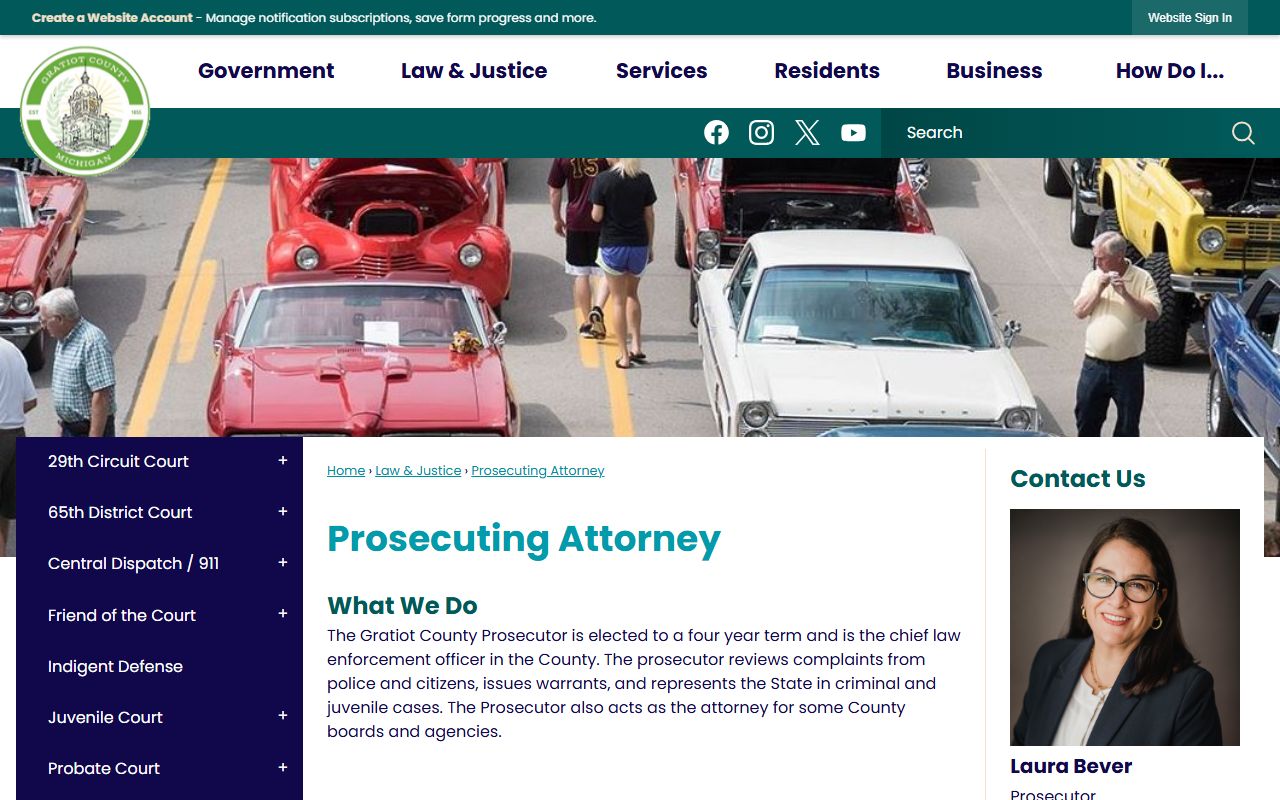
For public case copies and record checks, the better route is District Court, Circuit Court Clerk where applicable, MiCOURT, or FOIA for sheriff-held booking records.
Restricted Gratiot County Court Records
Not every arrest, warrant, or charge will appear in a public court search. The 65B live docket omits non-public cases. Juvenile matters, sealed proceedings, expunged records, active investigation records, and certain law-enforcement materials may be withheld or limited. County FOIA can be used for nonexempt sheriff records, but it is still subject to exemptions, redaction, fees, appeal rights, and the need to describe the requested public record with enough detail.
For background screening, use an FCRA-compliant consumer reporting process rather than casual public-record lookup. Court records after a Gratiot County jail arrest can be incomplete, old, amended, or legally restricted. A public case result should be verified with the originating court or office before any serious decision is made.
Important: This private resource is not a consumer reporting agency and must not be used for employment, housing, credit, insurance, or other FCRA-covered decisions.